Becoming Your Reliable Partner
-
+86 15218848900
-
+86 13288471981


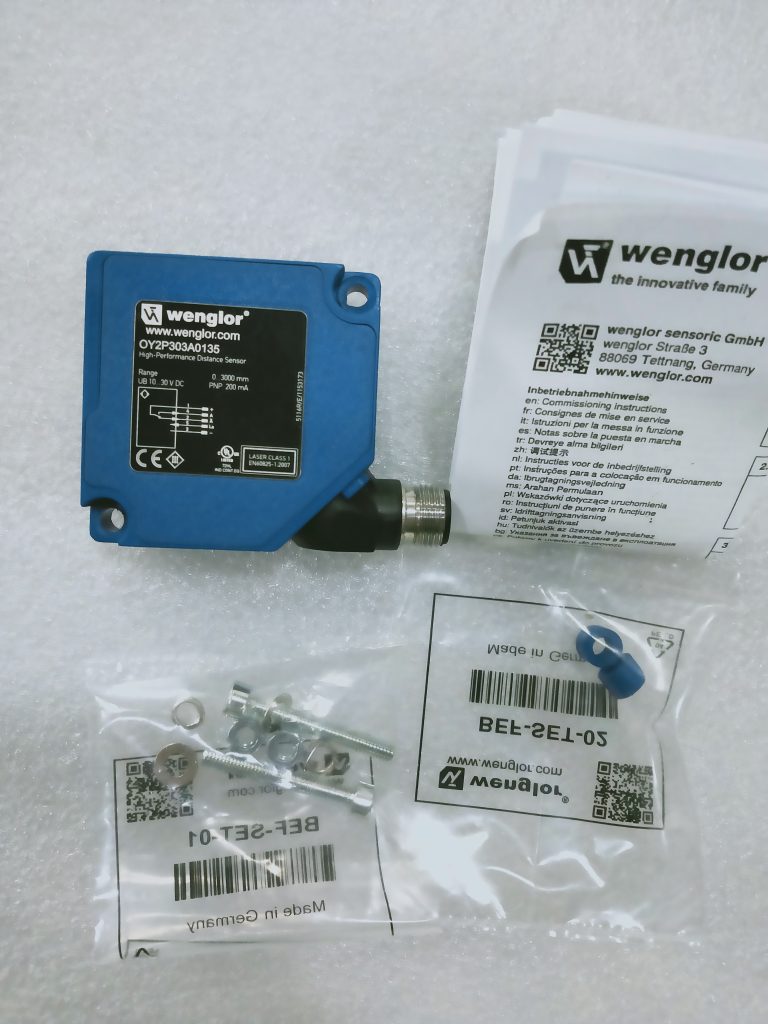
Wenglor OY2P303A0135 ToF Laser Distance Sensor Application Case
The Wenglor OY2P303A0135 ToF laser distance sensor was deployed on automated warehouse stacking equipment for pallet detection, with the fault reported as unstable detection signal. When operating, the sensor occasionally lost target signal, failed to identify pallet position and triggered stacker pause alarm intermittently.
In automated warehouse systems, such faults will cause stacker cranes to stop frequently, reduce warehouse throughput and bring risk of pallet collision.
What was noticeable was that the sensor sometimes worked normally. Normally, if the sensor hardware is completely damaged, it will continuously output alarm. Intermittent signal loss indicated possible interference or installation environment issue rather than permanent hardware breakdown.
Incoming inspection and initial diagnosis
During inspection, the wiring power supply was checked first. The supply voltage was 24VDC and stable. M12 connector wiring was tight without short circuit or loose contact.
Next, the sensor installation and optical path were tested. It quickly became clear that multiple sensors were mounted closely together. Adjacent sensors produced mutual optical interference under high-speed working condition.
At the same time, ambient light was roughly checked. Initial measurement showed strong ambient light reflection near the pallet metal surface. This indicated a combination of optical crosstalk and high ambient light disturbance.
Technical analysis
The Wenglor OY2P303A0135 is a Time-of-Flight laser distance sensor for non-contact object detection and distance measurement. It adopts Wintec anti-interference technology to suppress mutual interference between sensors.
In this case, the root cause was found in two areas:
First, unreasonable layout of sensor installation. Too dense arrangement made optical crosstalk occur occasionally, even with built-in anti-interference function. Typical causes are limited installation space on stacker and simple layout design.
Second, strong reflected light from metal pallets. Metal surfaces reflect laser strongly. Such disturbance is often caused by:
Metal pallet surface reflection, high workshop ambient light, improper sensor mounting angle, dust accumulation on lens.
The combination of optical crosstalk and laser reflection ultimately led to unstable detection.
A note from the manual: improper installation angle or dense multi-sensor layout may cause signal fluctuation.
Adjustment measures
The sensor assembly position was rearranged. Lens was cleaned and visually inspected.
The following work was carried out:
Adjust installation angle to avoid vertical reflection from metal surface
Rearrange sensor layout to reduce optical crosstalk
Clean dust and debris on sensor lens
Re-teach detection threshold for target object